Is self-castigation actually helpful?
Well, I didn’t get around to exploring the comparison between “my parents beat me as a child and I turned out fine” and “should”ing on myself in my post about “should”. I think I need to explore it though. Feel free to join me as I write things down in order to think them through.
Spanking1 “works”2 because children are trying to avoid negative consequences. The most obvious negative consequence is the physical pain of being spanked. Spanking also leads to a breakdown in the trust relationship between parent and child–a relationship where the parent is supposed to protect and nurture the child. Add to that the physical and psychological stress of being spanked leads to increased cortisol in the brain which then trains the brain to be more fearful3.
“Should”ing on myself “works” because I fear the outcome if I don’t live up to my expectations.
There is one glaring similarity between spanking and “should”ing on myself. They both capitalize on the fact that fear is a powerful motivator. A very powerful motivator. And really, that’s it. That is the comparison. Fear works as motivation. No one will argue that. Well, at least, I won’t argue that.
It’s also a lousy way to live. Plus the long term results are sketchy.
So maybe…don’t? I mean, that’s the logical conclusion, isn’t it?
But…Well… if not that, then what?
My interests in psychology and child development have led me to learn about fear based parenting and alternatives to fear based parenting. I’ve only really thought about how I could use these with any future children I may have and with the children I currently interact with (I love being an aunt). Maybe some of those alternative approaches to parenting can also apply to how I take care of myself.
Alright. Let me think4. What do I know that people can use as parents (especially of young kids) instead of spanking?
First of all, it is important to note that the only time someone is considering using spanking is when something is not going smoothly. No one, not even advocates of spanking, thinks, “My child is cleaning their room just like I asked them to. I’m going to go spank them.” So first recognize that the desire to use fear as motivation occurs when something we5 don’t want is happening. Remember, though, that “parenting6” doesn’t only happen in those stressful, dysregulated moments. Parenting during those hard moments begins during the not so hard moments. It begins with building a loving, trusting relationship with your child. It continues with noticing and understanding your child, figuring out what makes them tick. It further continues with making sure your child knows that your love is not dependent on what the child is doing. That way, WHEN (not if) the hard moments crop up, your child knows that you are both on the same team. Making it through the hard times is very much about the foundation that is laid before the struggle begins.
Supposing that foundation has been laid, then what? What about during those hard moments? What can you7 do rather than correct behavior using fear? Here are some of the strategies that I have come across, all phrased in the parenting context. Putting yourself in the role of both parent and child changes it to how to motivate yourself with something other than fear.
- During those hard moments, when emotions are high, recognize that the limbic system is in control. Broadly speaking, the limbic system is the part of the brain in charge of emotion and the frontal lobe is responsible for executive functioning (reasoning, decision making, planning, impulse control, etc.). If the limbic system senses any danger, it goes into full freak-out mode, and the frontal lobe goes to the backseat. And there is no backseat driving. Respond to the needs of the limbic system first.
- One of those limbic system needs is safety. This goes way beyond simply lacking an immediate physical danger. Isolation, shame, and criticism trigger the limbic system the same as if a lion was coming to eat you. It isn’t logical and it will not respond to logic. It will respond to love and compassion though.
- Once your child is able to talk8 to you, listen. How can they trust that you can help with their problems if you don’t listen to what those problems are? You, the parent, may think you know what the problem is. You may actually know what the problem is. You may understand it better than your child does. They don’t know that. They won’t know that until you allow them to tell you.
- Listening is so important it deserves a second bullet point. Listen all the way until they reach “the bottom of the well”. “Often, as well-meaning adults, we try to talk children, (and other adults, too) out of their feelings or give solutions. What they really want and need is to just be heard, and to let their emotions out without anyone judging those emotions as ‘wrong’, …or that they don’t feel as bad as they do. Just put your arm around [them] and listen. You will be amazed at the results… All because you let [them] go to the bottom of the well of [their] emotions…”9
- Validate. Emotions are not good or bad. They are feelings. These feelings can be helpful in deciphering our inner world. Paying attention to your child’s feelings can give you a glimpse into their inner world. Allowing them to feel what they feel and trust that they are feeling it is truly a gift.
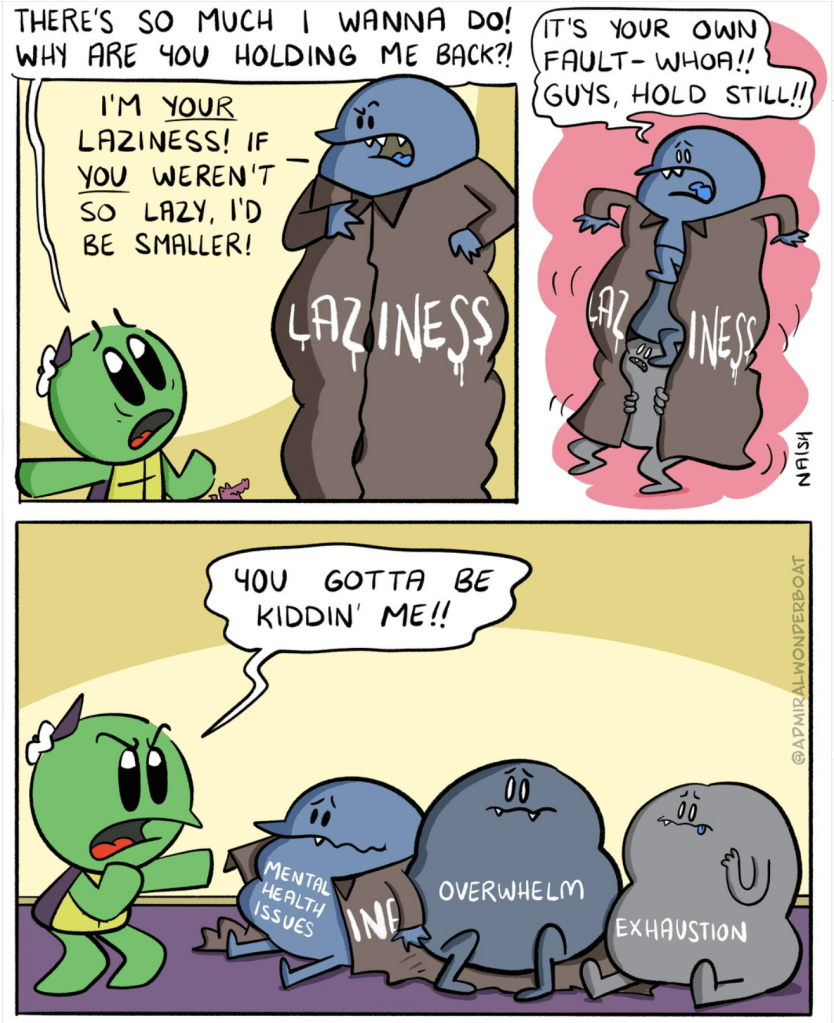
- Try to figure out what the real problem is–what is the actual obstacle? Does your child refuse to vacuum their room because the sound of the vacuum hurts their ears? Are they avoiding doing homework because they don’t understand the instructions? Is your child embarrassed that they dropped their violin rosin in the toilet and that’s why they won’t practice? Is their need for autonomy being overcome by their fear of failure? Sometimes laziness is really just mental health issues, feeling overwhelmed, and exhaustion wearing a trench coat. (See comic by Admiral Wonderboat on Instagram https://www.instagram.com/p/ChSCthvB1cK/)
- Lastly, work together to find a solution. Then check back in periodically to make sure everything is still okay.
One very important, underlying assumption runs through this approach. It is the assumption that people–you, me, children–are doing the best they can with the resources they have in the circumstances in which they exist.
People are doing the best they can with the resources they have in the circumstances in which they exist.
Let’s be clear: that’s kind of a tall order.
It means giving people the benefit of the doubt as a default, not only when we are feeling particularly charitable.
It means giving up an adversarial view and moving forward believing that we are all on the same team.
Parents are not fighting against their kids to make them do the right thing.
Parents are fighting alongside their kids against the obstacles they face.
But this isn’t a post about parenting. This is a post about me. My faulty worldviews.
Applying all of that to this new approach I’m exploring, it means that I have to believe that I am doing the best I can with the resources I have in the circumstances in which I exist.
I am giving myself the benefit of the doubt10.
I am no longer fighting myself to do the right thing.
I’m…
Hmmmm….I don’t really want to say “I’m fighting alongside myself” because that might be taking the comparison to a weird place. Though maybe I already took it to a weird place by putting myself in both the parent and the child roles. In any case, I’m not fighting myself. That seems like a good place to start.
I’m not fighting myself.
*I should probably mention that I’m not entirely certain I fully believe that this assumption is true. I just think that acting as though I believe it is true will lead to a better frame of mind for me. I’m going to try it and see how it goes.
Fear based motivation is such an easy go-to. I, for one, have many “should”s lurking in my peripheral vision, pulling my attention from what I am doing to a murky dimness that keeps me forever trying to flee a vague “or else”. Even when I manage to move my feet, rather than become paralyzed, it isn’t particularly enjoyable. And it definitely isn’t sustainable. It isn’t a life approach I would recommend to any of my loved ones, so why dogmatically adhere to it myself? I am more than capable of talking to myself (sometimes outloud, and sometimes only with facial expressions that I don’t realize the people around me can see…that’s embarrassing), I might as well let one of those inner voices be a loving parent who notices the good things I do and supports me through the not so good things I do.
Footnotes
- Yeah, I know, I went from talking about beating children to spanking children. I do not think that spanking your children is the same as beating your children. We can all pretty much agree that beating your children is a bad thing. Don’t do it. My personal belief is that spanking is not the best way to teach children. My personal belief…plus a bunch of research.
Gershoff ET, Grogan-Kaylor A. Spanking and child outcomes: Old controversies and new meta-analyses. Journal of Family Psychology. Published online 2016:453-469. doi:10.1037/fam0000191
S. Alexandra Burt, D. Angus Clark, Elizabeth T. Gershoff, Kelly L. Klump, Luke W. Hyde, Twin Differences in Harsh Parenting Predict Youth’s Antisocial Behavior, Psychological Science, 10.1177/0956797620968532, 32, 3, (395-409), (2021).
Kiviniemi, A.A.I., Koivumaa-Honkanen, HT.J., Heikkinen, H.P. et al. Is a harsh childhood growth environment reflected in parental images and emotional distress in adulthood?. Curr Psychol 41, 2194–2206 (2022). https://doi.org/10.1007/s12144-020-00696-2
Narvaez, D., Wang, L., Cheng, A. et al. The importance of early life touch for psychosocial and moral development. Psicol. Refl. Crít. 32, 16 (2019). https://doi.org/10.1186/s41155-019-0129-0
Anyway. For the purposes of this post, I will be talking about spanking rather than beating. ↩︎ - It can work for short term behavior modification. Sometimes. ↩︎
- Cuartas, J., Weissman, D.G., Sheridan, M.A., Lengua, L. and McLaughlin, K.A. (2021), Corporal Punishment and Elevated Neural Response to Threat in Children. Child Dev, 92: 821-832. https://doi.org/10.1111/cdev.13565 ↩︎
- No, really, I am figuring this out as I write. You are getting a bit of stream of consciousness going on. ↩︎
- I’m going with the assumption that this is something other people think/feel as well. It probably isn’t just me. So I feel safe saying “we” when I really mean “me”. ↩︎
- Ugh. What a vague term. What even is “parenting”? ↩︎
- By “you”, I definitely mean “I”. But just pretend that I’m writing this for your benefit rather than my own. ↩︎
- This implies that their frontal lobe is at least clawing it’s way back online. ↩︎
- This is an excerpt from a handout I once received titled “Listening and going to ‘the bottom of the well’”. I cannot find who wrote it. There is no citation provided on the handout and a Google search results in quite a few songs about the bottom of the well, but not what I’m looking for. I sincerely wish I could credit the person who wrote this. I also wish I could see what else they may have written. Sadly, I have been unable to do so. ↩︎
- Not really sure how that works… ↩︎
 Emotional Support Sisters
Leave a reply to When It’s Good – Emotional Support Sisters Cancel reply